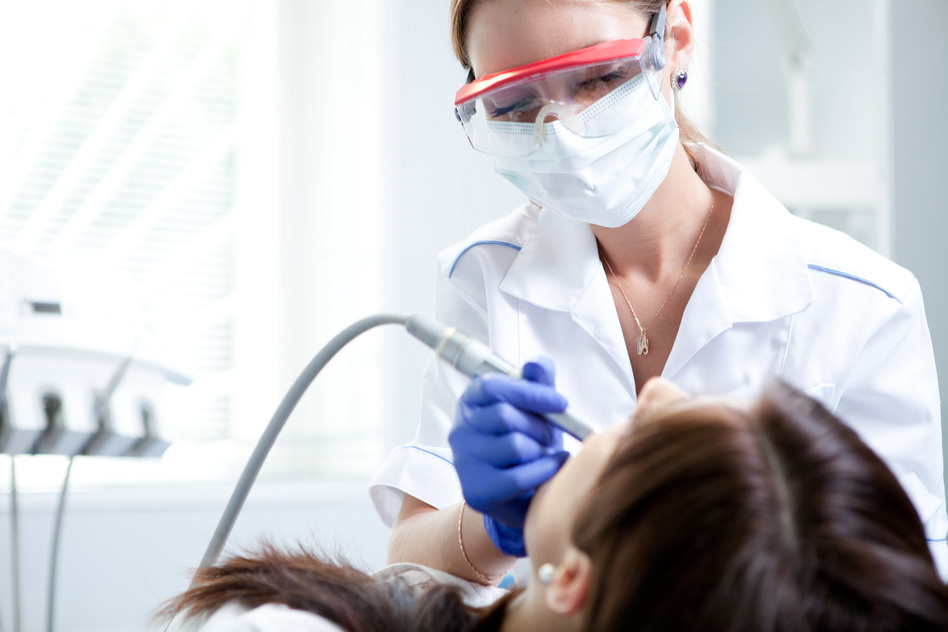
A treatment named Perioblast (Periodontal Biological Laser-Assisted Therapy) has been developed by oral surgeon Dr Francesco Martelli in Florence. It works by killing the bacteria that cause bleeding gums and loose teeth while encouraging the growth of new bone to help stabilise any already wobbly teeth – all without drilling or local anaesthetic.
Dr Martelli believes this approach will save teeth that would have to be pulled with the conventional method and ‘eradicates’ gum disease for good. The laser would also stimulate stem cells to establish new bone.
Losing teeth is something many of us have to cope with. The process typically begins with gingivitis, which occurs when ‘bad’ bacteria – plaque – cling to the teeth and harden into tartar. This irritates the gums, causing inflammation and possibly bleeding. Normally it is treated by a hygienist who will scale off the tartar. However, gingivitis can progress into periodontitis, when the bacterial build-up on teeth roots causes inflammation that damages the soft tissues and bone holding the tooth in place. ‘Pockets’ then form around the teeth, allowing bacteria to congregate.
The standard treatment for gum disease involves deep cleaning around the tooth root to remove plaque, and sometimes antibiotics to control the bacteria. But Dr Martelli says this is a short-term solution to a chronic problem: ‘Once the pathogens invade the dentine (the layer of tooth underneath outer enamel) the antibiotics cannot get to them as there is no blood supply.
‘And as soon as you stop the antibiotics, the pathogens will return and reinvade the tissue and bone and you face the same situation as before – you are not eradicating the problem.’
Dr Martelli’s treatment involves using a laser to reduce levels of harmful bacteria while maintaining beneficial bacteria. He takes annual swabs after treatment to check on the balance, and if the bad pathogens reappear, he gives a follow-up laser treatment.
Lasers are already used in dentistry to kill bacteria, but Dr Martelli says his method is different as it is completely non-invasive (others may need probes to be inserted into the gums).
Is this a dental miracle?
A study conducted by Dr Martelli and reported in the peer-reviewed European Journal of Clinical Microbiology & Infectious Diseases earlier this year would seem to support his claims. Each one of the study’s 2,683 patients had at least four laser treatments until the make-up of their mouth bacteria changed. Their gums were tested for bleeding, and pocketing around the teeth was measured before the treatment and at 12 and 24 months afterwards. All showed improvements. Swabs taken before and up to 24 months later showed the number of bacteria had reduced, and the type of bacteria had changed – with fewer ‘known pathogens’.
Other experts need more convincing though. ‘The problem isn’t solely about removing the bacteria, it’s also related to the body’s immune response,’ says Dr Francesco D’Aiuto, who heads the periodontology unit at the Eastman Dental Institute, University College London. Lasers have been used for periodontitis for 20 years – we know the light is antibacterial.’ In theory it could kill off the bad bacteria and not the good, he says, but adds: ‘All the studies done with lasers so far show they work against bacteria but have not found they are any superior to cleaning teeth by hand.’
Professional cleaning alone performed by a skilled hygienist every three months produces a substantial shift of the plaque from bad to good bacteria,’ he says. ‘ A single session of cleaning of the root surface removes most of the bacteria and it takes just one week for bacteria to recolonise it. ‘If a patient does not improve his or her oral hygiene, any dental treatment will fail to keep the root surfaces free from bacteria.
‘In the study, there was no control therapy – the authors cannot claim their treatment approach is effective as no comparison was performed.’ He adds, it is possible lasers can help regrow bone, however. ‘There is some evidence you can stimulate cells to repair – when you put light on anything it changes the status,’ says Dr D’Aiuto.
Source: Daily Mail