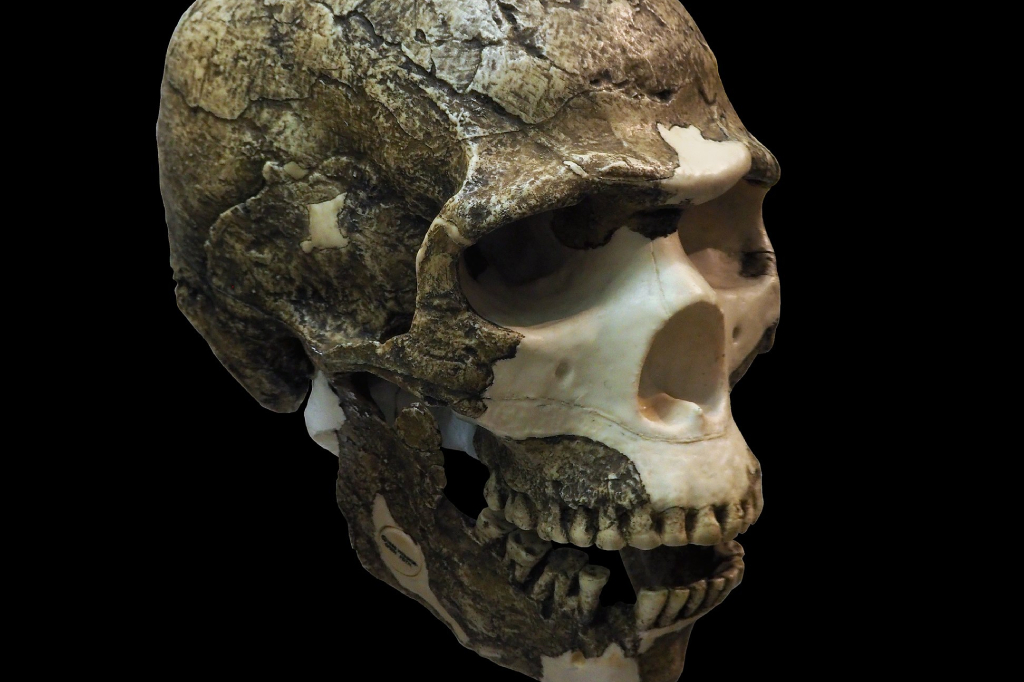
Exploring the mystery of predominant right-handedness in Homo sapiens unveils a fascinating journey through our ancestral dental records.
Homo habilis
Fossilized teeth of Homo habilis (handy man), display a series of ridges indicating a preference for tool use with the right hand. This corroborates the hypothesis that the bias towards right-handedness has deep evolutionary roots, dating back millions of years.
Fossil jaw insights
A two-million-year-old jawbone provides tangible proof of right-handedness in early Homo species. The markings on this fossilized jaw reaffirm the evolutionary persistence of right-handed dominance.
Neanderthal handedness
Scrutinizing Neanderthal teeth, dating back over 500,000 years, again exposes consistent right-slanting scratches. This evidence highlights the enduring nature of right-handedness across diverse human species, including our Neanderthal relatives.
OH-65 fossil evidence
The fossil OH-65, attributed to Homo habilis, preserves evidence of using the labial faces of anterior teeth as a cutting platform. This dental evidence further reinforces the early manifestation of right-handed behavior in our hominin ancestors.
Continuity in modern humans
Right-handedness may just be the way the brain is wired up with recent studies suggesting that up to 40 genes contribute to this trait. We may never know why our ancestors overwhelmingly used the right sides of their bodies, but we do know this a trait that is millions of years old.