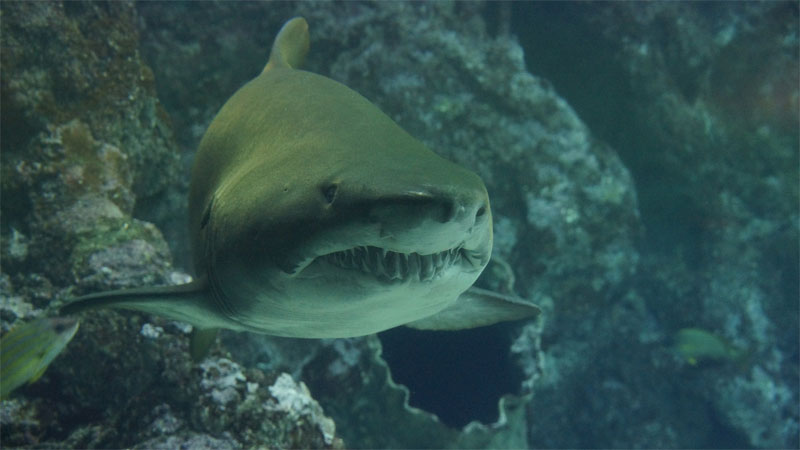
The teeth in your mouth have their origin in the scales of primitive shark-like fish, new evidence suggests.
Sharks and related fish lack bony skeletons and have skin containing tooth-like, spiky scales called dermal denticles. “Stroke a shark and you’ll find it feels rougher than other fish, as shark skin is covered entirely in dermal denticles,” said Dr Andrew Gillis at the University of Cambridge.
Their tooth-like appearance is no accident, according to new research by Dr Gillis and his collaborators. Over the course of evolution, dermal denticles moved from the skins of primitive fish to the mouth. From there, they could give rise to every vertebrate tooth that has come since, from the 28 centimetre canines of the sabre-toothed cat to the more modest teeth of humans. In this way, our teeth could represent a direct link between us and our distant evolutionary ancestors, the research suggests.
This new study represents the latest contribution to an on-going debate around the origins of teeth. The Cambridge research team examined the embryos of a little skate – a ray-like, cartilaginous fish related to sharks. They used fluorescent markers to label different types of cells in the skate embryos. In doing so, they found that dermal denticles are created from the same type of cells as teeth, known as ‘neural crest cells’.
“Neural crest cells are central to the process of tooth development in mammals,” said Dr Gillis. “Our findings suggest a deep evolutionary relationship between these primitive fish scales and the teeth of vertebrates.”
The fact that teeth and sharks’ denticle scales both arise from the same kind of embryonic cell suggests a common evolutionary origin, the team reported in the journal PNAS. The rough skin of sharks and their other cartilaginous relatives are the evolutionary leftovers of the armour plating that covered fish prior to the evolution of jaws around 400 million years ago. Teeth could be another remnant of this long history.
Dr Gillis and his collaborators suggest that over time, elements of this armour plating have been maintained in different vertebrate lineages while others have been lost.
Source: Independent